

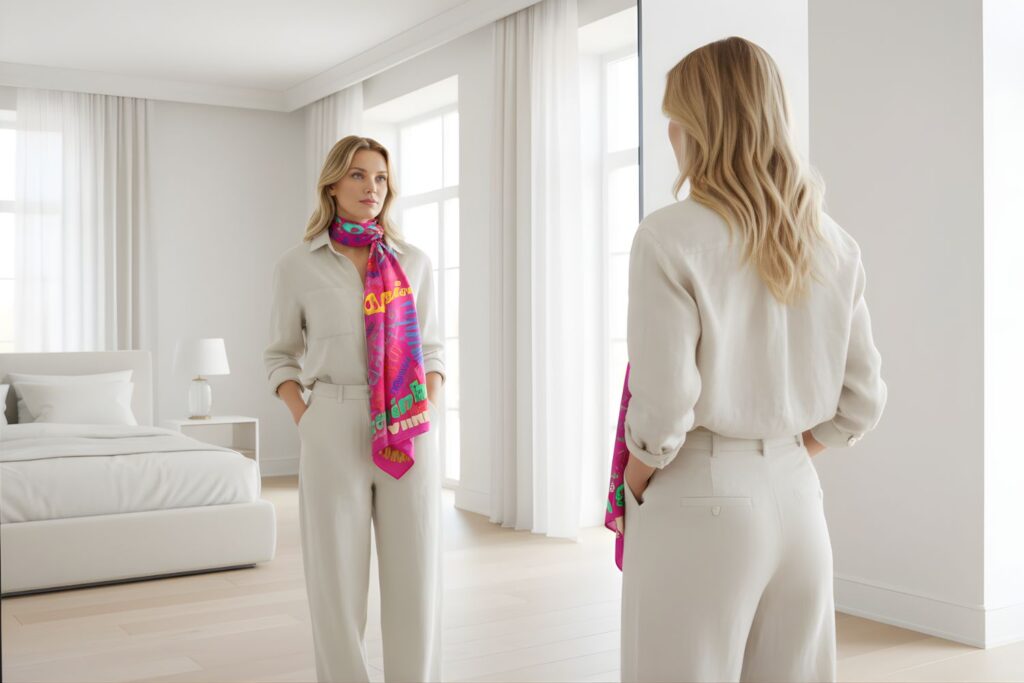
There are women who tell the truth because they’ve decided to.
Who practice honesty like a discipline, hold it up as a value, remind themselves to be transparent, and then there are women for whom the question never arises.
Not because they’re better, because there is simply no gap between who they are and what they say.
No distance to fill with something invented.
Truth as Structure, Not Virtue
She didn’t choose to be this way.
That process left something behind, a kind of internal architecture that makes dishonesty feel like wearing someone else’s body.
Possible, technically, but immediately wrong.
This is what most conversations about truth miss.
They frame it as moral, as something you do or don’t do, succeed at, or fail at, but for some women, it has nothing to do with ethics. It’s structural.
The lie would require a version of herself she no longer has access to.
She built herself out of something too solid for that.
The Mirror of Doubt
What made her this way wasn’t certainty, it was the opposite.
She allowed herself to feel uncertain, not to know, to say, out loud or just to herself, I don’t have this figured out yet.
Most people don’t do that.
Celeste let the doubt breathe, and in doing so, she found that it was hers, real, part of the actual texture of who she is.
Once you let the real thing in, even the uncomfortable real thing, you can’t go back to the imitation, the imitation stops fitting.
Envy Lives Somewhere She Doesn’t Go
Envy belongs to a specific kind of wanting: wanting what someone else has, without being willing to become who they had to become to have it.
It’s wanting the arrival without the road, the result without the forming.
Celeste doesn’t think this way, not because she’s above it, but because she rarely looks outward long enough for the comparison to take hold.
Her reference point is internal.
She follows her own heart, which means she follows a map no one else can read, toward places no one else has been.
You can’t envy someone else’s destination when you’re walking toward your own.
This is also why she doesn’t hide.
Hiding is envy turned inward, the conviction that who you actually are is not enough to get what you actually want, so you construct something more acceptable, more strategic, more likely to succeed.
Celeste never arrived at that conviction, she went the other way.
She went deeper into herself until she found something she could trust.
She Doesn’t Look Sideways
This is the part that’s hardest to explain to someone who hasn’t felt it.
She’s not disciplined about keeping her eyes on her own path.
She’s genuinely uninterested in anyone else’s.
Not dismissive, or isolated, just oriented entirely toward her own experience as the source of everything worth knowing about how to live.
The uniqueness in her life, the way she lands in places that surprise even her, is not something she aimed for, it’s what happens when you stop borrowing other people’s directions.
Somewhere original, not because you were trying to be original, but because you were only ever trying to be true.
Simplicity Over Correctness
She doesn’t tell the truth because it’s right.
That framing would make it a rule, and she doesn’t live by rules she didn’t make herself.
She tells the truth because it’s simpler.
Because the alternative would require maintaining a version of reality she didn’t create, tracking a story that isn’t hers, showing up as someone slightly different from who walked in.
It’s exhausting just to describe.
She can feel that exhaustion when she’s near it in others, the small adjustments, the strategic omissions, the version of the smile that doesn’t quite reach.
She feels it the way you feel a draft in a room.
Something is open that should be closed, something real has been replaced with something constructed.
She doesn’t judge it, she just knows it’s not for her, and she only wants what is hers.
Only wants what she’s willing to walk toward herself, and so she can only say what is true, because the truth is the only thing she has that is entirely hers.
What the Silk Knows
There is a reason certain things are made to move with the body rather than against it.
Silk doesn’t impose, it follows, it takes the shape of what it touches without losing what it is.
A small, quiet declaration that she knows who she is.
That she is not performing, that the woman inside and the woman visible are, more or less, the same woman.
Truth, at that level, stops being a quality, it becomes a texture, something you sense before you can name it.
Frequently Asked Questions
Why is truth so powerful in relationships?
Because it removes the work of maintaining an alternative.
When two people are truthful with each other, there is nothing to manage, no version to keep consistent, no gap to bridge between what was said and what is real.
What remains is actual contact.
Most people are starving for it without knowing that’s what they’re hungry for.
Is being honest always the right thing to do?
This question assumes honesty is a strategy, something you deploy based on whether it produces good outcomes.
For some women, it’s not a strategy at all, it’s just what they are.
The question of whether to be honest doesn’t really arise, the way you don’t decide every morning whether to speak in your own voice.
What is the connection between self-love and truth?
Self-love is what makes truth feel safe.
When you trust that who you are is enough, genuinely enough, not as an affirmation but as a lived conviction, there is nothing to protect with a lie.
The lie is a defense, self-love makes the defense unnecessary.
Why do people hide who they really are?
Usually because they arrived, somewhere along the way, at the belief that who they really are won’t be received.
That the real version is too much, or not enough, or too strange.
So they edit, they produce a version more likely to be accepted.
It’s not cowardice, it’s a very human adaptation to feeling unsafe.
Can you learn to be more truthful?
You can learn to be less defensive.
That’s the real work, not trying harder to tell the truth, but slowly loosening the belief that you need to protect yourself from being seen.
Truth tends to follow naturally from that, it doesn’t need to be practiced so much as uncovered.
Space Jungle Silk Scarf
Tapestry Of Star Birth Silk Scarf
Stellar Winds Silk Scarf
Cosmic Sketch Silk Scarf
Galactic Lounge Silk Scarf
Stars Hideout Silk Scarf
Majestic Spiral Silk Scarf
Celestial Dance Silk Scarf