

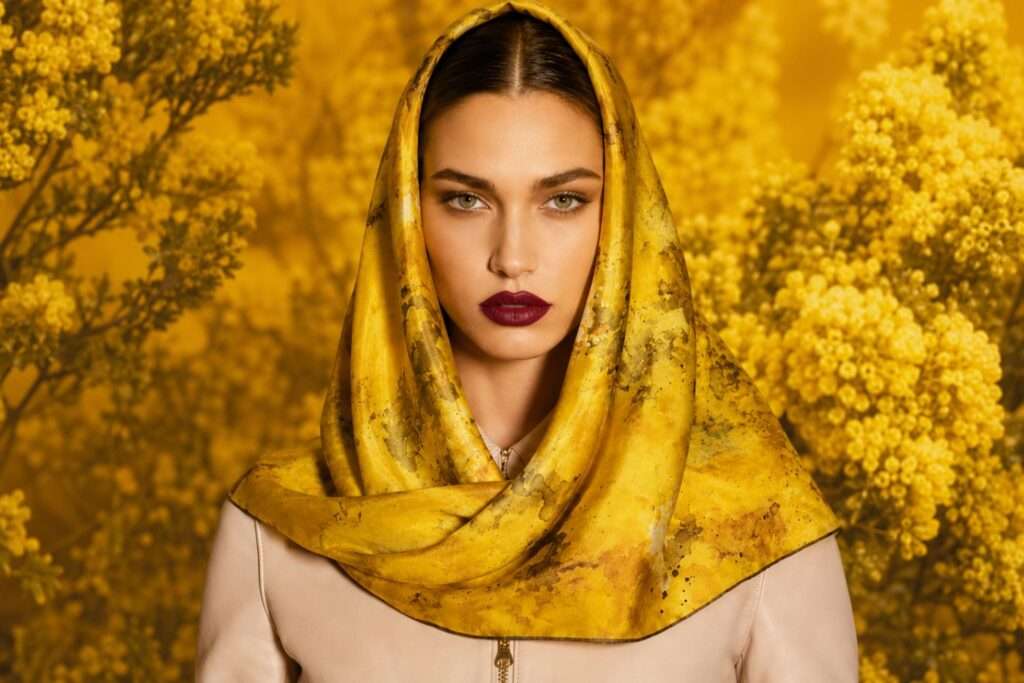
Some objects refuse to become obsolete, the silk scarf is one of them.
For more than two thousand years, it has crossed civilizations, survived revolutions, outlasted every trend declared immortal, and arrived here, still draped around women’s shoulders, still catching light, still asking something quiet of the person who wears it.
This is not a styling guide, It is not a buyer’s checklist.
It’s the story of an object that has always carried more than it weighs, and an honest look at why that matters now, when everything moves fast, and almost nothing lasts.
Where Silk Began
Silk is Chinese, that part of the story is not disputed.
What is disputed is exactly when, though the legend places the discovery around 2700 BCE, Empress Leizu, a mulberry tree, and a cocoon falling into tea.
Silk thread unraveling in the warm water, revealing the longest continuous filament nature knows how to make.
Silk moved west along the trade routes that would eventually carry its name, the Silk Road, wrapped around merchants, diplomats, monks, and explorers who understood that what they were carrying was not just fabric.
It was currency, status, and power all at once.
The Roman Empire imported it obsessively and condemned the obsession in the same breath.
Byzantine emperors made silk garments the exclusive property of the imperial family.
In medieval Europe, sumptuary laws dictated who could wear it, the social weight of the material was not a marketing invention, it was law.
Silk arrived in Como, in northern Italy, in the 1400s.
The city’s climate, cool, humid, fed by the lake, turned out to be almost eerily suited to silk production.
By the sixteenth century, Como was producing the finest silk in the world, and it still does.
How the Scarf Was Born
The silk scarf as we know it, the square, the carré, the piece of fabric designed to be worn and not simply to clothe, came later.
In ancient China, strips of silk were used as military insignia.
Roman soldiers wore a garment called a focale, a neck cloth, to protect the throat from armor chafing.
In the seventeenth century, Croatian soldiers in Louis XIV’s court wore knotted silk cravats that launched three centuries of neckwear obsession in European fashion.
But the object we recognize today, the square silk scarf, deliberately printed, meant to be seen, was a product of the twentieth century.
Hermès launched its first silk carré in 1937.
The design was equestrian, the format was 90×90 cm.
It was printed by hand with a technique that required up to thirty separate screens for a single design.
What Hermès understood, perhaps intuitively, was that a silk scarf is not really about the neck, it’s about the image of the person wearing it, what they want to say, what they want to feel, what they want the world to receive.
The fabric was already ancient, the genius was in understanding it as a vehicle for identity.
Why Silk Does What No Other Fabric Does
Silk is made of fibroin, a protein not unlike the proteins in human hair and skin.
This is not a poetic coincidence, it’s why silk feels the way it does against the body, recognized, almost.
Warm in winter, cool in summer, hypoallergenic, it does not absorb moisture the way cotton does, it breathes.
The thread that comes from a single cocoon can be between 300 and 900 meters long.
The work required to process it: unwinding, spinning, weaving, is staggering even by modern standards.
It moves differently from any other fabric.
It catches light at angles other materials don’t know.
This is not luxury as marketing, it’s luxury as fact.
The weight of a good silk scarf in your hand, the specific density of it, the way it pools rather than falls, is the accumulated result of thousands of hours of work and one of the most intricate biological processes on earth.
There are synthetic alternatives.
They look similar in photographs, but they do not feel the same, they do not behave the same, and they do not last the same.
The Twentieth Century: When the Scarf Became a Symbol
Grace Kelly, Audrey Hepburn, Jackie Kennedy, Sophia Loren.
The association between silk scarves and a particular kind of composed, unhurried femininity was not accidental.
These women understood, or intuited, that the scarf was doing something a dress cannot.
A dress clothes you, a scarf positions you, it’s the difference between a statement and a whisper.
In the 1950s and 1960s, the silk scarf became one of the most recognizable shorthand symbols of European elegance.
It was worn over the head in open-top cars.
Tied at the neck over sweaters.
Wrapped around handbag handles.
Used as a belt.
Later decades complicated that image.
The 1980s pushed louder statements.
The 1990s declared minimalism, and the scarf fell briefly out of fashion.
There is a pattern here worth noticing, the silk scarf does not follow trends, it waits for them to pass.
What a Silk Scarf Actually Means to the Woman Who Wears It
Ask the women who wear silk scarves why they do.
The answers rarely have anything to do with styling.
It was my grandmother’s, it was a gift at a moment that changed everything, I bought it for myself when I finally stopped waiting for permission, it makes me feel like myself, the self I forget on difficult days.
There is a category of objects that carry emotional weight the way silk carries light: without effort, without announcement.
The scarf earns that category not through sentiment but through history.
It has been given as an act of love for long enough that the gesture itself has accumulated meaning.
This is why the design matters.
Not as decoration, but as language.
A scarf’s pattern is the first thing the eye meets, it communicates before a word is spoken.
The best silk scarves are not designed to match outfits, they are designed to start conversations about who you are.
How to Recognize Real Silk
The market is full of impostors.
Polyester and satin scarves photograph beautifully and cost almost nothing.
Knowing the difference matters, especially if you are buying something meant to last.
Real silk has a specific weight.
It does not feel slippery in the way synthetics do, it feels dense.
Hold it to the light, it should have a natural sheen that shifts as you move it, not a flat, uniform gloss.
Rub a small section between your fingers, silk warms to your body temperature quickly, while polyester stays cold.
The burn test is the most reliable for fabric samples: real silk burns slowly, smells faintly of burning hair (because of its protein structure), and leaves ash that crumbles to powder.
Synthetic fabrics melt and bead.
This is not a test you run in a shop, it’s for when you have a question about something already in your hands.
Hand-rolled hems are another marker.
A machine-stitched hem on a scarf is flat, uniform, and quick.
It adds time to production, that time is part of what you are paying for, and part of why the scarf will still look right in twenty years.
For a more complete guide, this piece on identifying authentic silk scarves goes into each test in detail.
Why the Silk Scarf Still Matters
The question being asked more often now is not “Are silk scarves in style?” It’s something older and quieter: what does it mean to invest in a single object that lasts?
The conversation around fast fashion has changed something.
Not everywhere, not in everyone, but in enough women that a shift is visible.
There is a growing preference for fewer things that mean more, for objects with a story behind them, for the kind of quality that shows up not in photographs but in years of use.
A well-made silk scarf bought at thirty is still beautiful at sixty.
It’s one of the few things in a wardrobe that ages the way good wine ages, becoming itself more completely over time.
There is also something worth saying about the way it carries history.
Every silk scarf exists in a lineage.
The Silk Road, Como’s mills, the hand that rolled its hem, the woman who first wore it.
That lineage does not announce itself, it’s simply present, the way the weight of a thing well-made is always present, even when you are not thinking about it.
Some objects ask nothing of you.
The silk scarf has always asked, very quietly, that you be someone worth the wearing of it.
Most women who hear that question find they already are.
Frequently Asked Questions
What is a silk scarf used for?
A silk scarf is worn around the neck, over the head, tied to a bag, used as a belt, or wrapped around the wrist, the range is genuinely wide.
It is visible, it is chosen, and it communicates something about the person wearing it before they speak.
The most honest answer is that it is used for whatever the woman who wears it needs it to be.
What makes a silk scarf worth the price?
The production process.
Silk filament is extracted from silkworm cocoons, spun, woven in a specific structure (twill for most quality scarves), and then printed with a technique that can require dozens of separate color passes for a complex design.
A hand-rolled hem alone adds significant time per piece.
The result is a fabric that drapes, breathes, and behaves unlike anything synthetic, and that lasts for decades with basic care.
The price reflects what it actually takes to make it, not a markup on sentiment.
How do you wash a silk scarf without ruining it?
Cold water, a small amount of gentle detergent (or baby shampoo), and patience.
Never wring, submerge the scarf briefly, move it gently, rinse in cool water until the water runs clear.
Press between two clean towels to remove excess water, then lay flat or hang to dry away from direct sunlight.
Iron on the lowest setting, with the scarf slightly damp, or through a cloth.
A longer guide with specific scenarios is here.
Are silk scarves still fashionable?
Silk scarves have been called unfashionable in roughly every decade since the 1970s and have continued to appear on women who have no interest in that verdict.
The more useful question is whether a silk scarf will still feel right to you in ten years.
The answer is almost always yes, which is more than most fashion investments can offer.
They are not a trend, they predate the concept of trends by about two thousand years.
What size is a classic silk scarf?
The standard carré, the square format, is 90×90 cm.
This is the size Hermès established in 1937 and the size that has proven most versatile across the ways women actually wear scarves.
Smaller formats (around 45×45 cm, sometimes called a “pochette”) work well as bag accessories or hair ties.
Longer oblong scarves follow different proportions entirely and serve a different purpose.
For draping, knotting, and the full range of wearing options, 90×90 cm remains the most flexible format.
How do you store a silk scarf properly?
Flat, folded, away from direct light, and not compressed under other things.
Silk holds creases more readily than heavier fabrics, so the fewer folds, the better.
Avoid hanging for long periods, the fabric can stretch.
Keep away from heat and strong light, which affect both the dye and the fiber over time.
Acid-free tissue paper between folded scarves is worth the small effort for pieces you care about.
More details on long-term storage are in this guide.
Galactic Lounge Silk Scarf
Celestial Dance Silk Scarf
Winged Fairy-Tale Silk Scarf
Asterism Storm Silk Scarf
Celestial Iceblink Silk Scarf
Indigo Starburst Silk Scarf
Stellar Winds Silk Scarf
Tapestry Of Star Birth Silk Scarf