

There is a photograph of Coco Chanel, taken sometime in the 1930s, where she is wearing almost nothing remarkable.
A dark dress, simple shoes, and then, draped loosely at her neck, a rope of pearls, doubled, slightly off-center, as if placed by instinct rather than intention.
The dress disappears, but the pearls stay with you for years.
That is what an accessory does when it is chosen rather than just added.
It does not complete an outfit, it reveals something.
The Definition of Fashion Accessories
Fashion accessories are items worn or carried alongside clothing to complement, complete, or contrast a look.
The word comes from the Latin accessorius: that which accompanies.
It implies a secondary role, but the secondary is not always the lesser.
In music, the accompaniment is what makes the melody bearable for years instead of weeks.
What Counts as a Fashion Accessory
The simplest definition is: anything that is not a garment but is worn or carried as part of a dressed appearance.
This includes:
- Neck and shoulder accessories — scarves, necklaces, collars, ties
- Wrist and hand accessories — bracelets, rings, gloves, watches
- Head accessories — hats, headbands, clips, sunglasses
- Carried accessories — bags, clutches, wallets
- Waist accessories — belts, sashes
- Foot accessories — shoes, boots, anklets
Some categories blur.
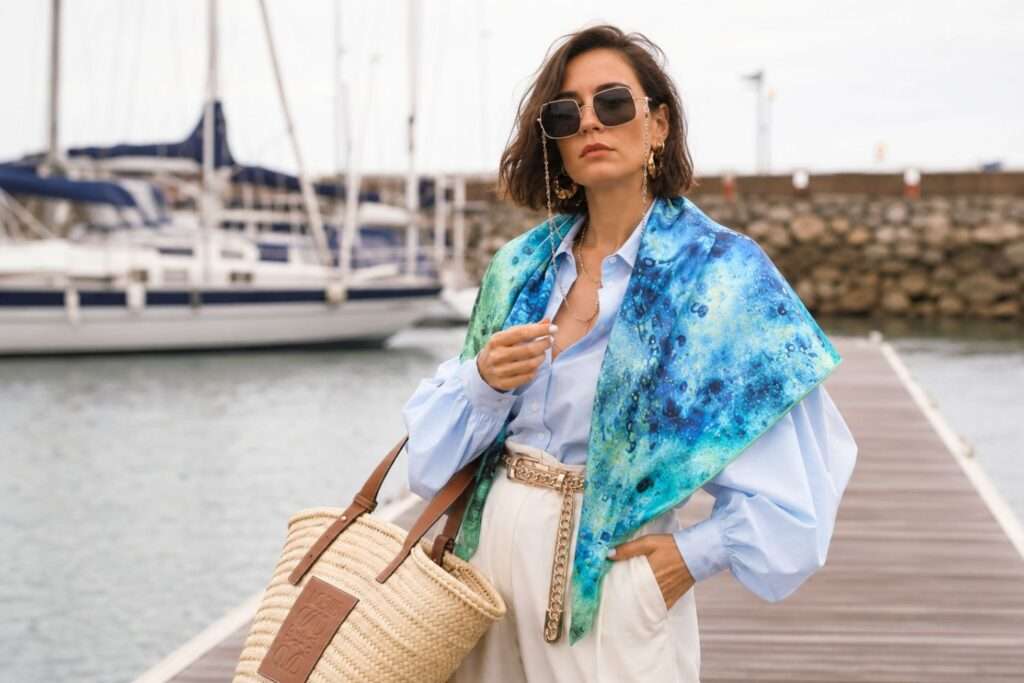
Is a silk scarf clothing or an accessory? It depends entirely on how it lives.
Tied at the neck, it is an accessory, worn as a top, it is clothing.
The object does not change, the intention does.
Why Fashion Accessories Exist at All
Before the modern fashion industry, accessories were practical.
Gloves kept hands warm, hats protected skin, belts held things in place.
The decorative and the functional were inseparable, beauty was a secondary discovery, not a primary intention.
Then something shifted.
Accessories became a part of dressing where self-expression could happen most freely.
Clothing, especially formal clothing, followed rules of occasion, of class, of decorum.
The accessory was smaller, cheaper, and easier to replace.
It could take risks that the dress could not.
This is still true.
A woman who wears the same coat every winter for ten years is not dressing badly.
She is spending her expression elsewhere, in the scarf she drapes each morning differently, in the earrings she chooses, the way other people choose moods.
The Difference Between Decorating and Choosing
There are accessories added to an outfit and accessories chosen for one.
The difference is felt immediately by anyone looking, though it is almost impossible to explain why.
An accessory that decorates fills a gap, it says: something was missing, I placed this here.
An accessory that is chosen says something else, something about the woman wearing it, about the things she notices, the textures she reaches for, the colors that feel like home to her.
The most memorable women in any room are almost never wearing the most accessories, they are wearing the right ones, chosen with the quiet certainty of someone who knows what belongs to her.
A silk scarf worn without thinking slides, one worn with attention settles.
The cloth is the same, the wearing is not.
The Role Accessories Play in Personal Style
Personal style is not a look, it’s a habit of seeing.
You notice what draws you, a particular blue, a specific weight of silk, a shape that appears in things you own without planning to collect them.
Accessories are where this noticing becomes visible.
They are also the part of dressing easiest to change.
Clothing is expensive, often occasion-specific, and slow to accumulate.
Accessories move faster.
For this reason, stylists often say accessories do more work per centimeter than any other part of a dressed appearance, not because they are showy, the best accessories are the opposite of showy, but because they are precise.
They are the details that make a silhouette specific to one woman instead of any woman.
Soft Accessories and Hard Accessories
Fashion often divides accessories into soft and hard categories, a distinction more useful than it sounds.
Soft accessories are made from fabric or flexible materials: scarves, shawls, ties, hats, gloves. They move with the body, can be worn in multiple ways, and change character depending on how they are held or placed.
Hard accessories are structured, rigid, or fixed in form: jewelry, belts with hardware, bags with frames, shoes, sunglasses. They hold their shape regardless of how they are worn. Their expression is more fixed, a ring does not change, but where it sits, and on whose hand, tells a different story each time.
Neither is inherently more elegant.
The choice between soft and hard is a choice between movement and structure, and the most interesting dressing often holds both at once.
Frequently Asked Questions
What is the difference between clothing and accessories?
Clothing covers the body as a primary garment: shirts, trousers, dresses, and coats. Accessories are worn or carried alongside clothing to complete or contrast the look. The line is not always clear. A hat can be protective clothing in one context and a purely decorative accessory in another. What distinguishes them is usually function first, then intention.
Is a scarf an accessory or clothing?
A scarf is typically considered an accessory, something worn to complement an outfit rather than serve as a garment. When worn as a top or wrapped as a skirt, it crosses into clothing territory. The object stays the same. What changes is how it is used, and what role it is asked to play.
What are examples of fashion accessories?
Scarves, necklaces, earrings, bracelets, rings, watches, bags, belts, hats, sunglasses, gloves, and shoes are all fashion accessories. The category is broad. What makes something an accessory rather than clothing is that it accompanies rather than forms the base of a dressed appearance.
What does “apparel accessories” mean?
Apparel accessories is a more formal term, used in retail and fashion industry contexts, to describe non-garment items sold alongside clothing. It covers the same territory as fashion accessories but with an emphasis on the commercial category rather than the wearing experience. Scarves, bags, jewelry, and belts are all apparel accessories.
Why are accessories important in fashion?
Accessories give a dressed appearance specificity. The same dress worn with different accessories tells a different story each time, about the occasion, about the mood, about the woman. They are a part of dressing most resistant to convention and most responsive to feeling. A woman who has found her accessories has found, in a small but real way, a part of her own language.
Majestic Spiral Silk Scarf
Intergalactic Spectrum Silk Scarf
Gas and Dust Silk Scarf
Tapestry Of Star Birth Silk Scarf
My Name Is Silk Scarf
Cosmic Reef Silk Scarf
Stars Hideout Silk Scarf
Galactic Lounge Silk Scarf