

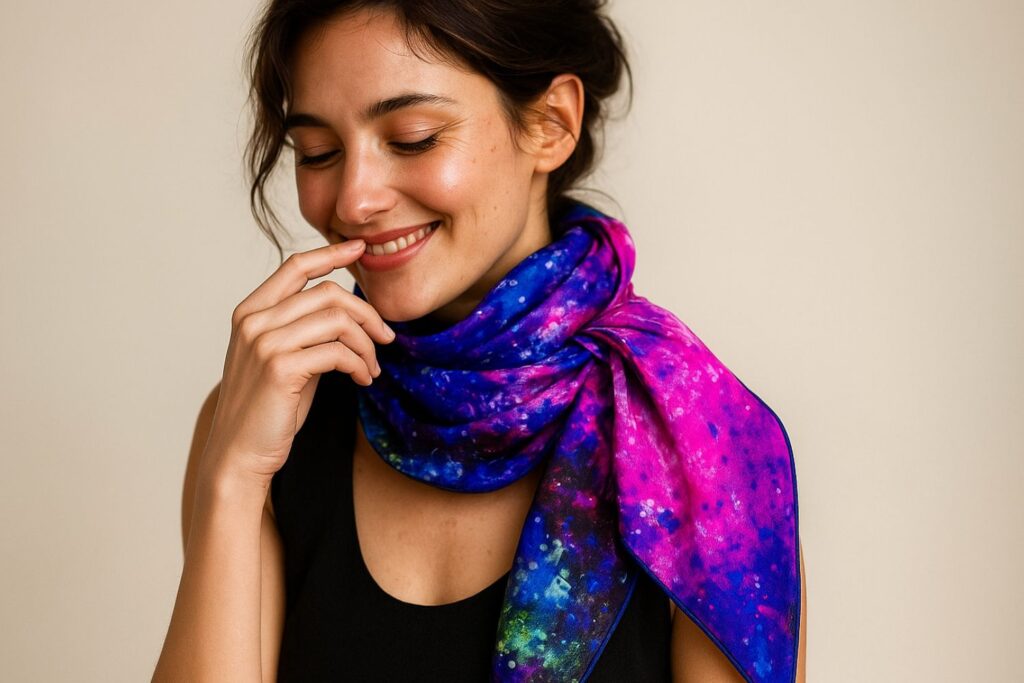
There is a kind of lightness that arrives with silk against skin, not the lightness of not caring, the lightness of having chosen, deliberately, to carry beauty as part of your day.
A silk scarf is not a trend, it’s not a finishing touch.
For the women who understand it, a silk scarf is a quiet declaration, of taste, attention to the life they are building, of the belief that how you move through the world matters, even on a Tuesday, even when no one is watching.
The Real Purpose of a Silk Scarf
The question “what is the point?” deserves an honest answer, not a practical one.
The point is not warmth, you have a coat for warmth.
It’s not fashion, fashion is seasonal and anxious, and silk scarves are neither.
The point, if there is one single point, is that a silk scarf makes the person wearing it feel more like herself.
It’s one of the few accessories that does not demand anything.
It does not nip, pinch, weigh, or pull, it rests.
It moves when you move, it catches light the way water does, differently every time, and it makes even the simplest outfit feel considered, complete, chosen.
There is a reason women of extraordinary elegance, Romy Schneider, Françoise Hardy, the women you spot in airports and immediately want to know, so often had a silk scarf near their face.
It has nothing to do with following a rule, it has everything to do with knowing that softness, placed correctly, is a form of power.
What a Silk Scarf Does for Your Skin and Hair
The practical benefits are real, and they are worth naming.
Silk does not absorb moisture the way cotton does.
Worn near the face or hair, it preserves rather than depletes.
No friction, nor compression.
Hair sleeps against it and wakes without creases.
Skin does not feel pulled or tight.
For women who have colored hair, fragile ends, or sensitive skin, this is not a minor detail.
The fiber itself is a protein, the same protein family that makes up skin and hair.
There is something almost logical about how silk behaves near both, it meets them gently, as if it knows the territory.
Worn as a hair wrap at night, a silk scarf preserves curl patterns, oils, and blow-outs.
Worn during the day, it shields hair and ears from wind and cold without static.
These are not the reasons you wears yours, but they are why you does not feel guilty about it.
How to Wear a Silk Scarf Without It Wearing You
The anxiety around silk scarves is almost entirely about not wanting to look like you tried too hard.
This is understandable, and also unnecessary.
The simplest approach is almost always the best one.
Loosely knotted at the neck. Not tight, not symmetrical. Let one end fall longer than the other. This is the way that looks effortless because it is effortless. It works with a white shirt, a trench coat, a fine-knit sweater.
Tied to a bag. A silk scarf knotted around the handle of a leather bag does something specific: it softens the whole silhouette. Color meets structure. It is one of the most effective styling moves that exists and it requires no mirror, no skill, no second opinion.
Worn in the hair. Folded into a thin band and tied at the nape, or wrapped loosely around a low bun. The French way, which is to say, without worrying about whether it is the French way.
Folded as a pocket square. For a blazer or suit jacket. A flash of color, a flash of personality, completely contained.
Draped over shoulders like a shawl. Particularly on summer evenings, when it is not cold enough for a jacket but the air has changed. This is a specific pleasure, the kind that makes you feel awake in your own life.
None of these require instructions.
You will find your own way, once you stop looking for rules and start paying attention to how the scarf moves when you move.
How to Wear a Silk Scarf for a Professional Look
The office, the client meeting, the board room, the pitch.
These are contexts where a silk scarf does something specific, it signals that you are put together without signaling that you tried to be.
A silk scarf at the neck of a structured blazer reads as authority softened by taste.
Not softened by concession, softened by choice, there is a difference, and everyone in the room can feel it even if they cannot name it.
For professional wear, go for classic tying.
The knot should sit just below the collar, easy, not centered, not fussy.
Neutral backgrounds with color, or deep solid tones.
Nothing with competing prints, let the scarf be one element in the conversation, not the whole conversation.
The 90cm square is the right size for this.
Large enough to drape properly, structured enough to hold a knot without disappearing.
Why Silk and Not Something Else
Every other material makes itself known.
Cotton is dense, wool is warm but weighty, polyester is slippery in a way that feels wrong, it catches air and falls incorrectly, like it is apologizing for existing.
Silk is different.
It has memory without rigidity, it catches light and holds warmth and moves with a specificity that no other fabric replicates.
Touch it and you understand why it was traded like currency for centuries, not as luxury, as necessity.
There is also the question of color, silk holds dye differently, deeper, cleaner, with more internal light.
The same color printed on polyester and on silk are not the same color, one sits on the surface, the other lives inside the thread.
This is why a silk scarf from an artist, not a brand, not a factory, but someone who designed something with intention, can hold a printed image the way no other medium can.
Each color exactly where it was meant to be, each shade carrying the light it was given.
The Question Beneath the Question
When someone searches “what is the point of a silk scarf,” they are not really asking about silk, they are standing in front of a mirror, or a shop window, or a website at eleven at night, and they are asking something else.
They are asking whether beauty is something they are allowed to want.
Whether caring about how they move through the world is frivolous, or if the impulse to choose something soft and precise and rare means something about who they are.
The answer to that question is not practical, it’s simply, yes.
It means exactly what you hope it means.
Frequently Asked Questions
What does a silk scarf actually do for you?
Beyond aesthetics, silk scarves protect hair from friction and breakage, shield skin from wind and cold without causing static, and preserve hairstyles overnight when used as a sleep wrap. For everyday wear, they shift the quality of an outfit without requiring any other change. Many women who start wearing them for practical reasons find they continue for entirely different ones.
Is a silk scarf worth the money?
Silk is a long-fiber natural protein that does not degrade the way synthetic fabrics do. A well-made silk scarf, stored and washed correctly, lasts for decades. The cost-per-wear on a piece worn hundreds of times is lower than most wardrobe items bought and discarded in a season. Whether it is “worth it” is a question only you can answer. But it rarely depreciates.
How to wear a silk scarf without looking overdressed?
The key is looseness. A silk scarf tied too tightly, too symmetrically, or too precisely looks like a costume. Let it settle naturally. Leave one end longer. Do not adjust it more than once. The women who look most at ease with a silk scarf are the ones who have stopped thinking about it.
Can you wear a silk scarf every day?
Yes, and many women do. A 90cm square in a neutral or versatile print works across contexts: professional, casual, evening. The variety is in how you wear it, not in how many you own. One silk scarf worn many ways accumulates more presence over time than a drawer full of accessories worn once.
What is the best size for a silk scarf?
The 90×90 cm square is the most versatile. It is large enough to drape over the shoulders, to tie at the neck with weight and structure, to fold into a hair wrap, or to knot on a bag. The 70cm square is more subtle and works beautifully for hair and neck. Longer rectangular scarves, around 180×45 cm, behave differently and suit different styles. Start with the square.
Cosmic Reef Silk Scarf
Tapestry Of Star Birth Silk Scarf
Stellar Winds Silk Scarf
Gas and Dust Silk Scarf
Supernova Blast Silk Scarf
Light Echo Silk Scarf
Indigo Starburst Silk Scarf
Galactic Lounge Silk Scarf