

There is a kind of woman who enters a room without entering it.
You feel her before you see her, not because of what she is wearing, or how much she spent, because of what she doesn’t need.
She doesn’t need your gaze to hold herself upright, or noise to be heard.
She has already arrived somewhere inside herself, and the room is simply where her body happens to be.
That is elegance.
Not a look, a state of being.
We have been taught to think of elegance as something expensive, something inherited, something that belongs to other women.
Women with better posture, better wardrobes, better circumstances, but that story is a lie told by people who had something to sell.
Real elegance doesn’t cost anything.
It costs you everything you were pretending to be.
What Elegance Actually Means
The word comes from the Latin eligere, to choose, to select with care.
Not to accumulate, to choose.
An elegant woman is not the one with the most, she is the one who has decided what matters and let go of the rest.
Her choices carry weight because they are genuinely hers, her words land because she doesn’t waste them, her presence settles because it isn’t performing.
Elegance, at its root, is discrimination in the old sense of the word.
The ability to distinguish between what is essential and what is noise, between what is true and what is expected, between who you are and who you have been told to be.
This is why elegance cannot be bought.
You can buy beautiful things, you can buy polish and training and excellent tailoring.
What you cannot buy is the ease of a woman who has made peace with herself.
That ease is the thing, everything else is just context.
The Elegance That Has Nothing to Prove
There is a version of elegance built on anxiety, on the fear of being seen as less than, it shows up as excessive grooming, as constant self-correction, as the restless need to be perceived correctly.
That is not elegance, that is performance, and performance is exhausting.
True elegance comes from the opposite direction.
It’s the composure of someone who is not trying to convince you of anything.
She knows her worth doesn’t require your confirmation.
She listens more than she speaks, not because she has nothing to say, but because she has learned that silence is often more precise than words.
Restraint is central to elegance.
Not repression, restraint, the difference is enormous.
Repression is holding something down.
Restraint is choosing when and how something is released.
An elegant woman doesn’t hide, she curates.
This connects to what the most enduringly elegant women have always understood, softness is not weakness.
It’s the oldest, most misunderstood form of strength.
The woman who can stay soft under pressure, who doesn’t harden or shrink or erupt, she is practicing a form of mastery that no rulebook can teach.
Elegance Is a Relationship With Yourself
You cannot be elegant toward others before you are elegant toward yourself.
Elegance in the interior sense means treating your own mind and body with discernment.
It means not flooding yourself with every thought that arrives, not consuming every piece of noise the world offers, not saying yes to things that leave you feeling less than whole.
It is a daily practice of returning to yourself.
Of asking, quietly: is this mine? Does this belong to me?
Finding your authentic self and finding your elegance are, in the end, the same journey.
Elegance is not a performance overlaid on top of who you are, it’s what remains when all the performance falls away.
A woman who knows herself, her values, her boundaries, the things she finds beautiful and the things she doesn’t, moves through the world with a specific quality of ease.
Not the ease of someone to whom nothing difficult has happened, the ease of someone who has met difficulty and is not afraid of it anymore.
That ease is what people are sensing when they call a woman elegant.
They are sensing that she is at home inside herself, and there is nothing in the world more compelling than that.
Elegance and the Way You Dress
Clothing becomes elegant when it serves the person wearing it rather than demanding attention for itself.
An elegant wardrobe is not a large wardrobe, it’s a considered one.
It holds pieces chosen with genuine care, pieces that reflect how you actually want to move through the world.
It has nothing to prove and nothing to shout, it speaks quietly, if at all.
Quality over quantity is the beginning, but it is not enough on its own.
The question is not only whether something is well-made, it’s whether it belongs to you.
Whether it aligns with the life you are actually living, or whether it is a costume for a life you think you should want.
Style can change with the seasons, elegance doesn’t.
Dressing with elegance is not about following aesthetic codes, it’s about dressing from a place of self-knowledge rather than self-consciousness.
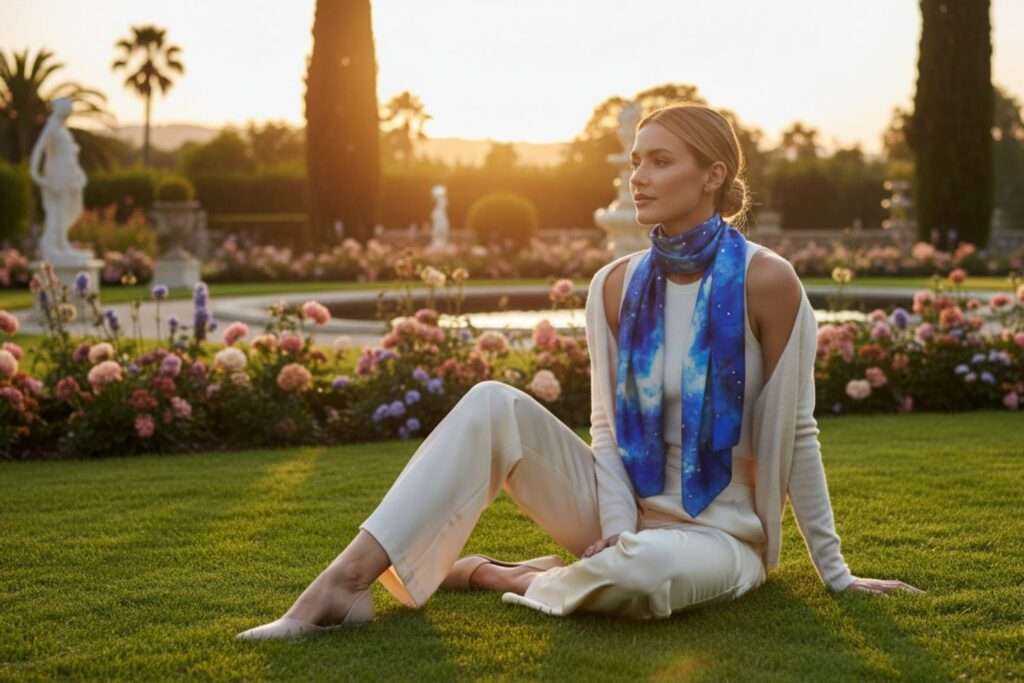
The way a silk scarf settles across a shoulder, without weight, without force, without need to hold, is elegance made cloth.
It doesn’t insist, it simply belongs there.
Elegance in How You Move and Speak
Posture is not about rigidity, it’s about being present in your own body.
The woman who walks like she has somewhere to be, not hurried, not performative, just directional, carries a different energy than the one who apologizes with every step for the space she takes up.
Your voice is also a form of elegance.
How you speak to people when you are frustrated.
Whether you reach for the cruelest available word or the most accurate one.
Whether you fill silence out of discomfort or let it breathe.
Elegant speech is not formal speech, It is precise speech.
Words chosen because they are true, not because they are impressive.
The ability to say a difficult thing without cruelty, the ability to disagree without contempt, the ability to leave a conversation and have the other person feel slightly more seen than before you arrived.
This is related to what etiquette, at its best, was always about, not rules of conduct for their own sake, but the practice of treating others with care.
Elegance and genuine courtesy come from the same source: the recognition that other people are real, and that how you treat them matters.
Elegance as Slowness
Speed and elegance do not coexist naturally.
In a world that rewards urgency, that mistakes busyness for value and noise for importance, elegance is a form of quiet dissent.
It says: I am not available for that pace, I choose to move through my life deliberately.
This shows up in small ways.
In not checking your phone the moment you feel a flicker of discomfort, finishing a meal before moving to the next thing, letting a conversation end naturally rather than rushing to fill the pause, choosing to own fewer things and take better care of them.
Cultivating presence in a fast-paced world is one of the most genuinely elegant things a woman can do right now.
Not because it is fashionable, slow living has become fashionable, which is its own kind of irony, but because it is the only pace at which you can actually feel your own life.
Elegance needs room.
It cannot exist in a life so full of noise that there is no space for stillness.
To accept that less, chosen carefully, is always more than more, chosen carelessly.
Feminine Grace and the Elegance of Becoming
Elegance is not a fixed destination.
It’s something you grow into, and also something you grow out of, if the version of it you were holding turns out to belong to someone else’s idea of who you should be.
Real elegance evolves.
The woman you are at forty carries a different kind of elegance than the woman you were at twenty-two.
Not less, more.
The edges are cleaner, the performance has worn away, what remains is more essentially herself.
This is why feminine grace is not about appearing a certain way.
It’s about being willing to keep becoming more truthfully yourself, even when that is uncomfortable, even when it requires letting go of the version others preferred.
Elegance, in its deepest form, is the courage to stop apologizing for who you are.
It’s not something you acquire, it’s something you remember.
Frequently Asked Questions
What does elegance really mean?
Elegance is the quality of someone who has stopped needing to perform.
It comes from the Latin word for choosing with care, and that is what it is: a practice of discernment, of selecting what matters and releasing what doesn’t.
It’s composure, precision, and the ease of a woman who is not trying to convince you of anything.
It has nothing to do with wealth or status and everything to do with self-knowledge.
Is elegance something you are born with or something you develop?
Neither, entirely.
You are not born elegant, but you are also not taught elegance in the way you are taught a skill.
It grows from the inside out, from the process of becoming more genuinely yourself, more at ease in your own skin, more willing to let go of what doesn’t belong to you.
Some women come to it early, most come to it slowly, all of them come to it through something real.
What is the difference between elegance and style?
Style is visible and can change, it’s the aesthetic vocabulary you choose: the colors, the cuts, the objects.
Elegance is invisible and doesn’t change with trends.
It’s the quality that makes any style look right on a specific woman.
You can have extraordinary style without elegance, and you can be deeply elegant in very simple clothes.
The two are related but they are not the same thing.
How can a woman become more elegant?
By investing in self-knowledge rather than appearance.
Learning to move more slowly, speak more deliberately, and choose more carefully in what she wears, in what she says, in how she spends her time.
Practicing restraint not as repression but as curation, and by being willing to let go of the performance of elegance, which is the very thing that prevents the real thing from emerging.
What is quiet elegance?
Quiet elegance is elegance that needs no announcement.
It doesn’t dress for attention or speak to be noticed.
It’s the quality of someone so settled in herself that she has no need to signal anything.
It’s subtle, durable, and once you have seen it, impossible to confuse with anything else, it’s the kind of beauty that you feel first and notice second.
Does elegance have anything to do with age?
Elegance and age are related, but not in the way we are sometimes told.
It’s not that older women are automatically more elegant, it’s that the things which produce elegance, self-acceptance, ease, the willingness to stop performing, tend to come with time and experience.
The woman who has stopped trying to be everything to everyone has more space for elegance than the one still trying to earn her place.
In that sense, yes, elegance often deepens with age.
Can elegance be learned?
The surface elements of elegance such as posture, the pace of speech, the way you dress, can be refined with attention, but the deeper quality cannot be learned in the conventional sense.
It’s cultivated, slowly, through the ongoing process of becoming more honest with yourself.
You cannot learn your way to elegance, you can only shed what has been covering it.
Light Echo Silk Scarf
My Name Is Silk Scarf
Winged Fairy-Tale Silk Scarf
Cosmic Sketch Silk Scarf
Supernova Blast Silk Scarf
Space Jungle Silk Scarf
Gas and Dust Silk Scarf
Stars Hideout Silk Scarf