

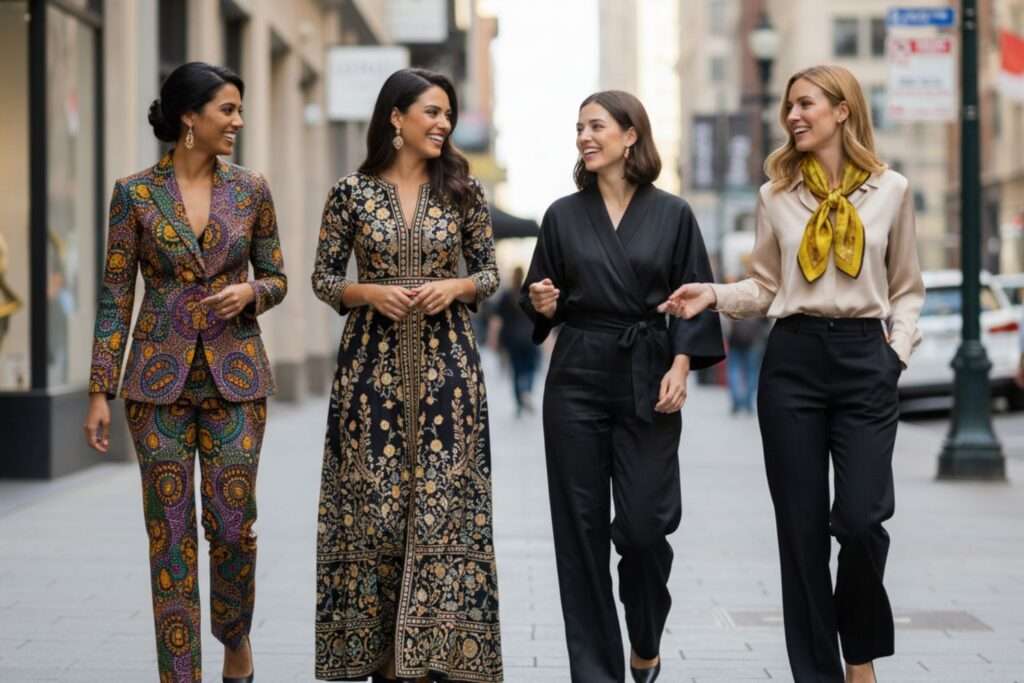
We often speak of clothing as a personal choice, a statement of style.
But look closer.
Every stitch, every fold of fabric, every chosen hue is a whisper from a deeper well.
Fashion is not merely what we wear, it is the skin of our collective soul, a living archive of who we are, where we’ve been, and what we silently believe.
It is culture made tangible, woven into form.
The Fabric of Society: More Than Adornment
To see fashion as mere adornment is to hear a symphony as only noise.
From the ceremonial kimonos of Japan, where the wrap and fold convey respect and social order, to the defiant safety pins and tartan of 1970s punk, clothing embodies our values.
It negotiates the space between the individual and community.
A sari tells a story of region, marital status, and artistry passed through generations.
The clean lines of modernist minimalism reflect a cultural appetite for clarity and intentionality in an age of noise.
Silk as a Silent Historian
Consider the journey of a single material: silk.
For millennia, it traveled the Silk Road, not just as a commodity, but as a cipher.
In ancient China, it was a symbol of imperial power and divine connection.
As it moved west, it became currency, a luxury that shaped economies and sparked wars.
In its sheen, we see the reflection of trade routes, diplomatic alliances, and the human yearning for beauty that transcends borders.
To hold a piece of heritage silk is to hold a map of human connection.
At Cosminha, we see each scarf as a page in this ongoing chronicle, a soft-strength canvas where personal narrative meets this ancient, flowing history.
Ritual, Rite of Passage, and the Clothes That Hold Them
Our most profound cultural moments are dressed.
The white wedding gown, a relatively modern tradition speaking of transformation and hope.
The academic robe, a medieval relic asserting the continuity of knowledge.
The quinceañera dress, a vibrant declaration of coming of age.
These are not costumes, but vessels.
They carry the weight of expectation, the blessing of a community, and the vulnerability of transition.
They allow the individual to step into a predefined role, to be held by the fabric of tradition while writing their own line within it.
Subculture and the Semiotics of Resistance
Culture is not monolithic, and neither is its expression.
Fashion becomes a potent tool for subcultures to carve out identity in the margins.
The zoot suits of the 1940s, the leather jackets of rock ‘n’ roll, the logomania of streetwear, each create a coded language.
It is a way to say “we see the world differently” without uttering a word.
This is where fashion reflects culture’s undercurrents, its tensions, and its evolving edges.
It is dialogue, and sometimes, it is dissent cut and sewn into a silhouette.
The Personal as Cultural Microcosm
Ultimately, the macro-narrative of culture is worn on the micro-scale of the individual.
Your grandmother’s lace collar kept in a drawer, the specific way you knot a scarf learned from a friend in another country, the vintage piece you repaired, these are acts of cultural curation.
We each become archivists, selecting fragments of the collective tapestry to wrap around our own stories.
In this act, we acknowledge that while fashion reflects the culture we come from, it also, quietly, shapes the culture we are creating.
A Closing Reflection
To dress with consciousness, then, is to engage in a profound act of storytelling.
It’s to understand that the garment you choose today is part of a longer, richer conversation.
It carries the echoes of looms, the dreams of designers, the revolutions of streets, and the intimacy of heirlooms.
It is an opportunity to wear your introspection, to drape yourself in meaning.
Let your choices be deliberate, let them be beautiful, let them be true.
For in the end, the most luxurious statement you can make is to wear your understanding.
FAQs: How Fashion Reflects Culture
What is the relationship between fashion and cultural identity?
Fashion is a primary, non-verbal language of cultural identity. It communicates heritage, social status, beliefs, and community belonging. Through traditional dress, religious garments, or subcultural uniforms, individuals signal their place within a collective narrative, preserving history and expressing solidarity.
How does traditional clothing reflect a culture’s history?
Traditional clothing is a condensed archive. Materials (like silk or wool) speak to local resources. Motifs and patterns often hold symbolic meanings, telling stories of mythology, social rank, or regional identity, and techniques passed down through generations carry intangible heritage, making history wearable and tactile.
Can fashion influence culture, or only reflect it?
The influence is a dynamic dialogue. While fashion reflects existing cultural values, it also actively shapes them. It can challenge social norms (e.g., gender-fluid silhouettes), accelerate political movements, and create new communities. Designers and wearers alike become agents of cultural change.
What is an example of cultural appropriation vs. appreciation in fashion?
Appropriation takes sacred or significant cultural elements out of context for trend or profit, often stripping away meaning and credit. Appreciation involves deep respect: understanding the context, honoring the source, often through collaboration, and elevating the narrative rather than exploiting the aesthetic.
How is globalization affecting cultural expression in fashion?
Globalization creates a fusion of influences, leading to innovative hybrid styles. However, it risks homogenization. The counter-movement is a powerful resurgence of interest in local craftsmanship, indigenous techniques, and hyper-local narratives. A desire for authenticity and depth in a connected world.
Tapestry Of Star Birth Silk Scarf
Celestial Dance Silk Scarf
Gas and Dust Silk Scarf
Intergalactic Spectrum Silk Scarf
Cosmic Reef Silk Scarf
My Name Is Silk Scarf
Space Jungle Silk Scarf
Galactic Lounge Silk Scarf