

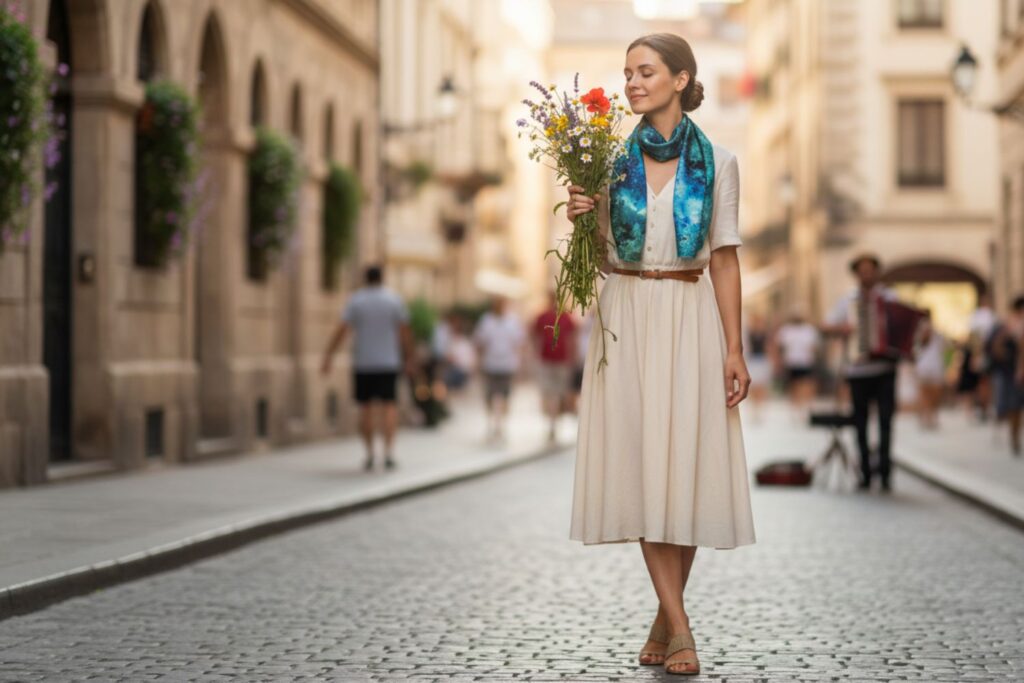
There is a woman who gives the way the sun gives light, without keeping score, and without a ledger open somewhere in the back of her mind.
She brings flowers to your table, listens past the hour, remembers the small things you mentioned once in passing.
Love is not her motive.
She acts because she cannot help it, because this is simply who she is.
Most people have met her, very few have understood her.
Why the World Finds Her Suspicious
The world has a complicated relationship with this kind of woman.
It finds her generous and then wonders what she wants in return.
It accepts her gifts and grows suspicious of their weight, because the world is mostly transactional, and it assumes everything is.
Even kindness, even love.
So it invents explanations.
These explanations say more about the world than they do about her.
Because there is another possibility, one that is harder to categorize and therefore rarely named.
She gives because she is full.
Not full of certainty, not without her own sorrows and contradictions, full in the deeper sense, rooted in herself, connected to something that does not run dry.
What Giving Without Expecting Anything in Return Actually Looks Like
It looks quiet. That is the first thing.
It does not announce itself, or wait to be noticed.
It does not require the other person to receive it in exactly the right way.
A woman who gives from love does not rehearse her generosity before offering it.
She does not feel diminished by a lack of acknowledgment, and she does not revise her opinion of the person who forgot to say thank you.
Her giving is clean, there is no residue of expectation left behind.
This is what separates generosity from performance.
Performance needs an audience, generosity does not even think about one.
The Oldest Form of Giving
There is a particular kind of love that sustains without owning.
A mother who has truly loved knows it.
She holds the child close, and she knows from the very beginning that her whole task is to let go.
She gives her warmth, her time, her attention, and she asks nothing back, not even that the child remember to be grateful, or that the child become who she hoped.
This love is the oldest form of generosity.
It predates philosophy and religion, it’s what the word love was reaching for before we complicated it.
The woman who gives without expecting carries this memory inside her, not necessarily from her own mother.
Sometimes from a teacher, a friend, or a moment in a garden when she was very young.
She remembers people loving her so freely that freedom became her native language, the one she speaks now, in everything she gives.
She Is Not a Saint. She Is Not Naive.
Others have taken advantage of her, she knows what betrayal feels like, and she has learned, sometimes painfully, that not everyone receives a gift gracefully.
She has her limits, her silences, her days when she has nothing left to offer.
Yet she is not afraid of her own generosity.
She does not ration it out of self-protection, she does not arm herself against the possibility of giving too much, because for her, giving is not a wound waiting to happen, it’s an expression of who she is.
Shutting it down would be shutting herself down.
She is also not soft in the way the world sometimes assumes.
She is confident, she does not shrink in competition.
She is generous the way a strong tree is generous with its shade, not to please the people resting beneath it, simply because that is what trees do.
The Difference Between Giving and Sacrifice
Sacrifice starts from lack.
It gives what it cannot afford to give and then keeps a silent record.
It gives from the place that fears: if I don’t give enough, something will be taken from me, love will leave, approval will vanish, and I will be left with nothing.
It does not deplete.
Strangely, it seems to renew itself in the act.
The woman who gives from love knows this difference in her body.
She knows the hollow exhaustion of giving something she could not afford, she has been there.
She also knows the other feeling, the one that comes when she gives freely from her real abundance and walks away feeling somehow more herself than before.
What Cosminha Recognizes in Her
A silk scarf placed around a shoulder without ceremony, the way a hand rests briefly on an arm to say: I see you.
That is what this kind of giving feels like.
It does not bind, it does not ask to be held, it offers its warmth and remains, quietly, for as long as it is wanted.
Cosminha was made for this woman.
Not to tell her who to be, she already knows, only to reflect back what she carries.
That her way of loving is not excess, it’s not a flaw in need of correction.
It’s one of the rarest things in the world.
A love that gives because it cannot help giving, because it was born that way.
Frequently Asked Questions
Is it healthy to give without expecting anything back?
It depends entirely on where the giving comes from. When you give from genuine fullness, from love, from who you are rather than from fear of what will happen if you don’t, it tends to feel natural and self-renewing. When giving comes from anxiety, from needing to be needed, or from the hope of an unspoken return, it depletes. The question is not whether you should give without expecting. The question is whether your giving is an expression of yourself or a negotiation you haven’t admitted to.
Why do some people give without expecting anything in return?
For some people, generosity is not a decision. It is a disposition. A way of being in the world that was formed early, shaped by love they received or love they witnessed, or sometimes love they chose to become after being starved of it. These people give because holding back would feel like holding their breath. It is not performed virtue. It is simply their nature.
What is the difference between giving from love and giving from fear?
Giving from fear leaves a residue. A small resentment, a quiet expectation, a part of you waiting to see how the gift will land. Giving from love leaves nothing behind. It is complete in the moment of giving. The person who gives from love does not track, does not calculate, does not feel smaller after giving more.
Can someone who gives too much learn to give from a healthier place?
The question is worth sitting with. “Too much” is often a sign that the giving is coming from the wrong place, from need rather than abundance. The path is not usually to give less, but to understand what the giving is trying to secure. Once that is clear, the giving tends to find its right proportion on its own. Some people discover, in doing this work, that they were never giving too much. They were simply giving to the wrong people.
How do you give without expecting anything back when it hurts?
There are times when giving freely is painful. When you offer something real and it is met with indifference, or taken without acknowledgment. The answer is not to harden. It is to grieve the specific loss, not the act of giving, but the connection that did not meet your gift. Then to return to yourself. What she lost was a moment. What she is, no one can take.
Stars Hideout Silk Scarf
Tapestry Of Star Birth Silk Scarf
Space Jungle Silk Scarf
Space Chip Silk Scarf
Majestic Spiral Silk Scarf
Winged Fairy-Tale Silk Scarf
Supernova Blast Silk Scarf
Gas and Dust Silk Scarf