

Run your fingers across a silk scarf, a real one, and there’s something the fabric communicates before your mind catches up.
A faint diagonal texture, a weight that moves but doesn’t slip, a light that doesn’t show off, it just holds.
That is silk twill, the purity behind it, the reason the color lands so deep, and the softness feels almost implausible, is Mulberry silk.
They are often mentioned together because they belong together, but they describe entirely different things, and understanding the distinction changes how you see every piece of silk you’ll ever own.
Mulberry Silk: Where the Fiber Begins
Mulberry silk is not a type of fabric, it’s the origin of the thread itself.
The silkworm responsible is the Bombyx mori, a species that feeds exclusively on mulberry leaves.
This specific diet is not incidental, it produces a filament that is longer, finer, and more uniform than silk from any other source.
The result is a fiber that is naturally white, exceptionally smooth, and strong enough to outlast most other textiles while feeling almost weightless on the skin.
What sets Mulberry silk apart is the consistency of its thread.
The filament runs for hundreds of meters without breaking, which means fewer joins, fewer irregularities, and a surface that catches light evenly rather than in scattered bursts.
It drapes without stiffness, it breathes without feeling thin.
For people with sensitive skin, it is one of the few truly hypoallergenic natural fibers.
Other silks exist: Tussar, Eri, Muga, each with their own character, but Mulberry silk is the standard against which the rest are measured, and has been for centuries.
Silk Twill: Where the Weave Takes Over
Once the Mulberry fiber exists, a decision has to be made about how to construct the fabric from it.
That decision determines everything: how the textile moves, how it drapes, how it ages, how it holds a knot.
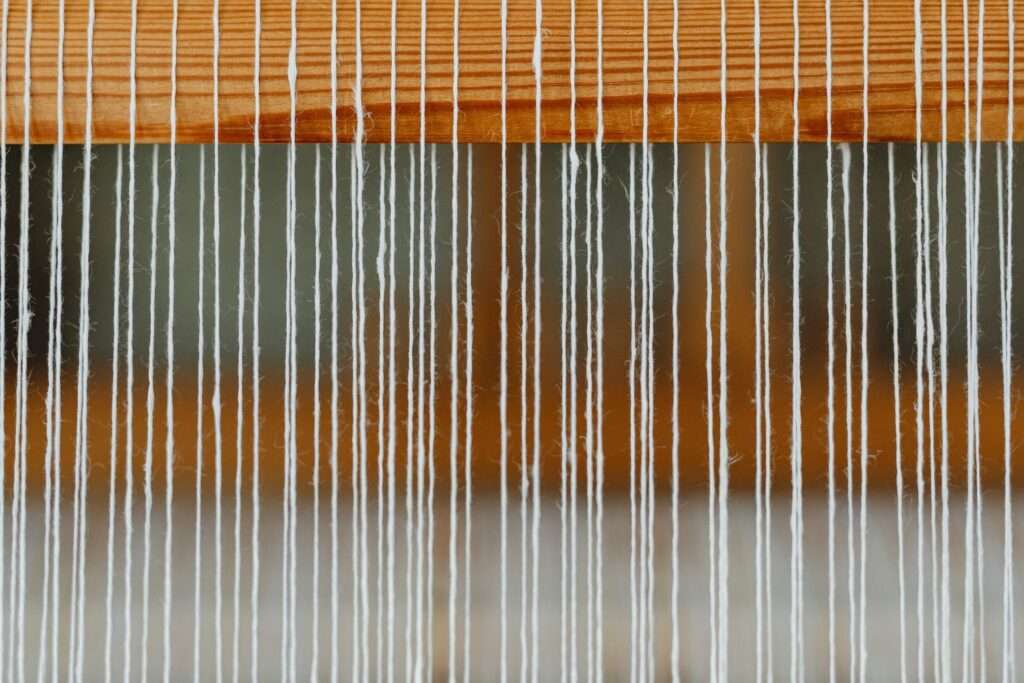
Silk twill is a weaving method.
The loom passes each thread over two or more threads in a sequence that repeats at an offset, creating a characteristic diagonal rib across the surface.
If you look closely at a quality scarf in good light, you can see this pattern.
More often, you feel it before you see it, a faint grain under your fingertips, softer than it sounds but undeniably present.
This diagonal structure does something practical: it distributes tension evenly across the fabric.
Where a plain weave might crease or pull, twill recovers, it resists wrinkling naturally, it holds a fold without making it permanent, and because of how the threads cross, it drapes with a fluidity that neither goes limp nor fights gravity, it simply follows, gracefully.
The weave also does something unexpected for printed designs.
The diagonal grain catches light at multiple angles, which gives the color more dimension.
A print on silk twill doesn’t just sit on the surface, it seems to be inside the fabric, held within it.
Why Heritage Houses Use This Specific Combination
The pairing of Mulberry silk fiber with a twill weave is not accidental, it’s the answer arrived at independently by most of the great silk houses over generations of experimentation.
Mulberry silk provides the purity.
The long, even filament gives the finished fabric a softness and sheen that cannot be replicated with synthetics, regardless of how closely they try to approximate it.
Twill weaving provides the structure.
Without some method of adding durability and body, silk, however pure, can be too delicate for daily use, prone to slipping, and difficult to work with in design terms.
Together, they create a material that is genuinely difficult to improve on.
The history of silk scarves is largely the history of this combination being refined, not replaced.
Cosminha scarves are made from 100% Mulberry silk twill, the same base used by the heritage houses in Paris and Lyon.
The difference lies in what is put onto the fabric, designs that begin not from tradition but from instinct, from color poured and layered until something inside says stop.
How Silk Twill Feels and Ages
New silk twill has a slight structure to it, it’s not stiff, but it has presence.
After wearing, after folding, after the kind of lived contact, a good scarf accumulates over years, it softens in a specific way, not to limpness, to something warmer, more personal.
A silk scarf that has been worn will always feel different from one that hasn’t, and it will always feel better.
The surface finish is what is often called a matte luster, it reflects light without being shiny.
In direct sun, it glows, in shadow, it holds color well, deeper and more saturated than almost any other woven textile.
This is why silk twill has been the material of choice for artistic scarf design.
The fabric rewards complexity, it makes prints look like they were painted from within.
Knots and folds also behave differently on twill.
The diagonal weave means the fabric holds a tied shape without slipping.
You can loop a scarf loosely, and it stays, you can tie a structured knot, and it will not unravel over the course of a day.
For styling, this matters more than it might seem, you can read more about the possibilities in how to wear a silk scarf and what to do with silk scarves.
Silk Twill and Sustainability
Mulberry silk twill is fully biodegradable.
When its life cycle ends, it returns to the earth cleanly: no residue, no synthetic persistence.
The silkworm’s diet is a single plant, the fiber is a single protein, the weave requires no chemical bonding agents to hold its structure.
This is not a minor point in a period when most “luxury” textiles are built from polyester, regardless of what their marketing claims.
A polyester scarf that costs three hundred euros is still a piece of plastic.
A Mulberry silk scarf is, at every level of its construction, a natural object.
The question of how to care for it, and how to make it last for decades, is worth taking seriously.
How to wash and care for silk scarves covers this in full, and how to store silk scarves addresses what to do between wearings.
A piece cared for well can last a generation.
There’s also a simpler case to be made: one scarf worn for twenty years is not the same as twenty scarves worn for one year each.
Quality and sustainability are the same argument, approached from different angles.
How to Recognize Real Silk Twill
Because the combination is so valued, it is also imitated.
Synthetic twill weaves exist, satin-finish polyesters are sold as “silk-like.”
Knowing the difference matters, both for what you’re paying and for what you’re wearing against your skin.
The most reliable home test for real silk is a burn test: a small thread from a seam, held briefly to a flame.
Real silk chars and smells faintly of burning hair, it stops burning when the flame is removed.
Synthetic fiber melts, smells chemical, and may continue to burn.
If the piece is too intact to pull a thread from, there are other methods covered in how to identify authentic silk scarves vs synthetic ones and how to tell if it’s real silk.
Beyond the burn test, real silk twill has a specific weight to it, substantial without being heavy.
It warms to body temperature quickly, and it has that diagonal texture, subtle but present, that no silk imitation has yet managed to replicate convincingly at close range.
There is no competition between Mulberry silk and silk twill because they do not compete.
One is the material, one is the method.
Together they produce a fabric that has remained the basis of luxury silk design for generations, not because of tradition, but because nothing has come close to replacing it.
Frequently Asked Questions
Is Mulberry silk the same as regular silk?
Mulberry silk is real silk 100% natural, produced by the Bombyx mori silkworm.
What makes it specific is its source: silkworms that feed exclusively on mulberry leaves.
This produces a finer, more uniform filament than other silk varieties. I
t is the highest-quality form of silk, not a different material from it.
What is the difference between silk and silk twill?
Silk is the raw fiber.
Silk twill is what you get when that fiber is woven using a diagonal rib pattern.
In the same way that wool can be woven into different fabrics with different textures and uses, silk can be woven in multiple ways: plain, satin, chiffon, twill.
The weave changes the feel, the drape, the durability, and how the fabric behaves in use.
Twill gives silk structure without stiffness.
Is silk twill a good fabric for scarves?
It’s probably the best fabric for scarves.
The diagonal weave adds body so the scarf holds its shape when tied.
Heritage houses have used it for their square scarves for decades, and the reason is simply that it works better than the alternatives.
How do I know if my scarf is real Mulberry silk twill?
Weight, texture, and the burn test are the most reliable indicators.
Real Mulberry silk twill has a distinctive feel: soft but with some substance, not slippery.
Run your fingers across it at an angle to the weave, and you will feel the faint diagonal grain.
A thread held to a flame should char and smell of hair, not melt.
A more complete guide is available at how to identify authentic silk scarves vs synthetic ones.
Does Mulberry silk twill last?
With reasonable care, yes, for decades.
The long filament of Mulberry silk means fewer weak points in the thread.
The twill weave distributes stress evenly across the fabric.
Together, they produce something that does not wear out in the ordinary sense.
It softens, it acquires a quality of being worn-in that new silk does not have.
Hand washing in cold water, flat drying, and careful storage are enough to keep it in good condition for a very long time.
Space Chip Silk Scarf
Cosmic Reef Silk Scarf
Celestial Iceblink Silk Scarf
Intergalactic Spectrum Silk Scarf
Cosmic Sketch Silk Scarf
Stars Hideout Silk Scarf
Galactic Lounge Silk Scarf
Winged Fairy-Tale Silk Scarf