

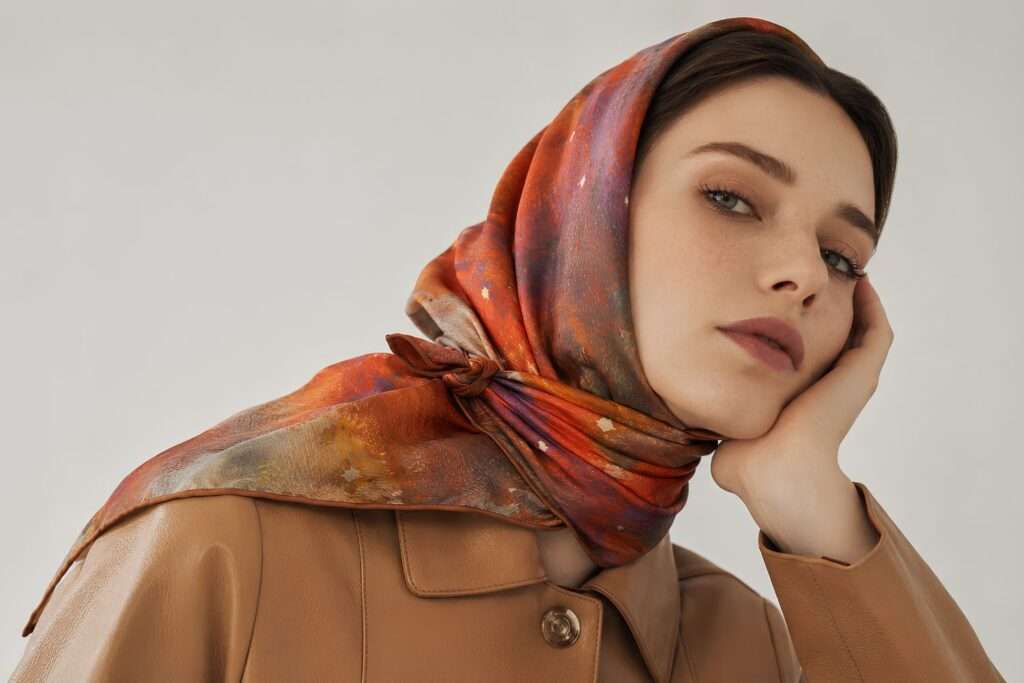
Some things earn their place quietly.
You stop noticing them because they stopped being an effort.
The silk scarf you reach for without thinking, the one that has lived through enough mornings that it now carries a particular light.
That is the kind of scarf worth knowing about before you spend anything.
This is not a list of the most expensive options, it’s a guide to what separates silk that lasts from silk that disappoints, and which scarves, across different aesthetics and price ranges, actually deliver on what the category promises.
What Makes a Silk Scarf Worth the Investment
Before the brands, the question itself is, are silk scarves worth it?
The honest answer is that it depends entirely on which silk you are talking about.
There is a version of this category that absolutely justifies the cost, and a version that trades on the word while delivering very little of what it implies.
The difference comes down to three things.
The weight of the fabric
A quality silk scarf feels substantial without being heavy. When you lay it flat, it does not collapse into itself. It has body. The momme weight, the unit used to measure silk density, matters here.
Anything below 12mm tends to feel thin and disposable. The best scarves for everyday wear sit between 14mm and 16mm.
The finest ones, built for longevity and the kind of drape that photographs like a painting, reach 18mm to 22mm.
The print
Screen-printed silk carries color into the fiber, digital printing sits on top of it. The difference is visible over time: one deepens, the other fades.
A scarf with a screen-printed design, particularly twill silk, will look better in its fifth year than it did in its first.
The distinction between mulberry silk and silk twill is worth understanding before you decide, because they serve different purposes and the better choice depends on what you actually want the scarf to do.
The hem
Rolled hems, finished by hand, are the detail that separates considered craft from factory production. They are also the first thing to show wear if the construction is poor.
Run a finger along the edge of a scarf before you buy it. If the roll is even and tight, the rest of the construction is probably honest.
How to Recognize Real Silk Before You Commit
The category attracts imitation.
Satin, polyester and viscose blends are marketed with enough ambiguity to mislead, and some of them feel convincing in a photograph or under flattering light.
Knowing how to tell if it is real silk is not pedantic, it’s the difference between buying something that will soften and age with you and buying something that pills by spring.
Real silk warms to the touch within seconds of contact.
Synthetic fabrics stay cool or become slightly tacky.
The burn test, holding a loose thread to flame, remains the most definitive: real silk burns slowly, smells faintly of hair, and leaves an ash that crumbles cleanly. Synthetics melt, bead, and smell of chemicals.
If you are buying from a boutique or market and have any doubt, these ways to identify authentic silk scarves versus synthetic ones will not waste your time.
The knowledge pays for itself the first time you are about to make an expensive mistake.
The Brands Worth Knowing
At the top of the category, Hermès remains the reference point, not because its scarves are objectively the finest silk available, but because they have built seventy years of trust into the act of buying one.
The 90×90 cm carré, printed in Lyon, hand-rolled at the edges: it is as much a statement of continuity as it is a textile.
The question of which brand has the best silk scarf almost always circles back here, and it is worth understanding why, and what it actually costs you to go elsewhere.
Ferragamo and Gucci occupy the next tier, their scarves inherit the vocabulary of Italian tailoring: rich color, bold graphic geometry, hems that hold their shape.
The quality is consistent, the brand logic is different from Hermès, more fashion, less institution, and that shows in the designs.
Among independent and smaller luxury labels, the landscape has shifted considerably in recent years.
Brands working with artisan printers in Italy and France, using mulberry silk sourced from single regions, have produced scarves that rival the heritage houses in material quality, while offering something the large houses rarely attempt: designs that feel genuinely singular, made from instinct rather than brief.
What Makes a Cosminha Silk Scarf Unique
Cosminha belongs to this space.
What follows is not technique, it’s surrender.
Layers of color built without a map, the process continuing until something inside says stop.
The logo does not appear until the design is finished, placed at the exact point where the work found its center.
There is no equivalent to this in the mainstream luxury category.
Silk vs Satin: The Confusion Worth Clearing Up
Satin is a weave, silk is a fiber.
They are not the same thing, though the confusion is so common it has started to shape purchasing decisions in ways that consistently disappoint.
A satin scarf is usually polyester woven in a satin pattern: smooth on one side, dull on the other, and unmistakably synthetic against the skin after a few hours.
A silk scarf woven in a satin weave is a different matter: softer, warmer, with the sheen of genuine luxury.
The full comparison between silk and satin scarves covers this in enough depth to make the difference legible the next time you are standing in front of something being sold as both.
What a Silk Scarf Actually Does
This is the question beneath all the others.
The point of a silk scarf is rarely what people say it is when they are trying to justify the purchase.
It’s not primarily a warmth layer, or a styling trick, it’s the particular way that something genuinely beautiful, worn against the body, changes how the wearer moves through a room.
Silk has thermoregulating properties, it is cooler in summer and warmer in winter than synthetic alternatives, and it is one of the few textiles that are genuinely beneficial for both hair and skin over sustained use.
But those are arguments for a spreadsheet, the real reason is simpler: it changes something.
The difference is not visible, it is felt in the way it settles, in the way it moves, in what it asks of the person wearing it.
For Occasions That Deserve Something Deliberate
A silk scarf is among the most considered gifts in the category, not because of its price, but because of what it communicates.
It implies a specific kind of attention to the person receiving it, to what they carry well, to what they would not buy for themselves but immediately understand when they see it.
The art of luxury gifting is really the art of choosing something that arrives already knowing its recipient.
A silk scarf from a brand that makes each design once, from instinct, not schedule, tends to do this better than one printed in seasonal runs.
It’s already singular before it becomes personal.
How to Wear It Without Instructions
The best scarves resist instruction.
They are generous enough to be knotted loosely at the neck, folded into a headband, tied at the handle of a bag, or left undraped over a shoulder in the way fabric falls when no one is watching it.
The ways to wear a silk scarf are worth knowing not as a formula but as an opening, a starting point that the scarf itself will push past once you stop thinking about it.
The most honest advice is to begin with how it wants to fall.
A scarf made with enough intention has an opinion about this, trust it.
What to Look For in a Summary
Before you decide, the things that actually matter:
- Momme weight between 14mm and 22mm for lasting quality
- Mulberry silk as the fiber base, not silk blends
- Screen-printed or hand-painted design rather than digital-only printing
- Hand-rolled hems, even and tight along all four edges
- A brand with a traceable creative process, one that can tell you how the scarf came to look the way it does
- A design you can still see yourself wearing in ten years without effort
The last point is the one most often ignored.
A scarf is not a seasonal purchase for anyone who cares about wearing it well, it’s a long companion, buy accordingly.
Frequently Asked Questions
Are silk scarves worth the money?
For real mulberry silk at an appropriate weight, yes, consistently. The fiber is durable, improves with age, and carries color differently than any synthetic alternative. The investment only disappoints when the silk is low-grade, blended, or printed in a way that fades quickly. A scarf made properly will outlast most of what surrounds it in a wardrobe.
Which luxury brands make the best silk scarves aside from Hermès?
Ferragamo and Gucci offer reliable quality in the Italian tradition, with strong graphic design and consistent craftsmanship. Among smaller and independent luxury labels, Cosminha produces a singular category of scarf: mulberry silk twill, hand-rolled hems, momme 18mm, and designs born from a completely instinct-led process that begins with real photographs of the cosmos.
Each design is made once. That is not a marketing position, it’s the actual production logic.
What is the difference between a cheap silk scarf and an expensive one?
Weight, print quality, and hem construction. A cheap scarf will feel thin, have a digital print that sits on the surface rather than living in the fiber, and have machine-stitched edges that fray with handling. An expensive one has density, color that deepens over time, and edges that show craft in the evenness of the roll. The gap between them is tactile before it is visible.
How do I know if a silk scarf is real silk?
Real silk warms immediately against skin, has a weight and drape that synthetics cannot replicate, and burns with a slow, hair-like smell when a loose thread is held to flame. Synthetic fabrics melt and smell chemical. When buying online, look for momme weight listed explicitly, any brand working with real silk will know this number and share it.
What size silk scarf is most versatile?
90×90 cm is the most versatile square size, large enough to be worn as a neck scarf, headscarf, top, or bag accessory, while remaining portable. The 70×70 cm is cleaner for hair or smaller neck knots. Oblong scarves in the 180×90 cm range offer more styling options for outerwear but are harder to drape casually. For a first silk scarf, 90×90 cm is the most honest recommendation.
Celestial Dance Silk Scarf
Indigo Starburst Silk Scarf
Black Hole Silk Scarf
Stars Hideout Silk Scarf
Cosmic Reef Silk Scarf
My Name Is Silk Scarf
Tapestry Of Star Birth Silk Scarf
Supernova Blast Silk Scarf